Protect What Matters: Why Every Business Needs a Cyber BIA
A Cyber Business Impact Analysis (BIA) serves as an essential resource for organizations to comprehend how cyber events might affect their operations and to determine necessary measures to lessen the impact. It helps in pinpointing vital systems, processes, and data, evaluating possible repercussions, and prioritizing resources for recovery and resilience.
In a world increasingly reliant on digital infrastructure, businesses face a growing barrage of cyber threats. From ransomware attacks and data breaches to system downtimes and insider threats, the cost of a cyber incident has never been higher.
While many organizations invest in cybersecurity services and advanced tools, they often overlook this critical cyber resilience component.
A Cyber BIA doesn’t just identify vulnerabilities — it maps out exactly how a cyber attack would affect your business operations, revenue, reputation, and compliance posture. If your organization hasn’t yet conducted one, you’re flying blind in the face of rising digital risk.
What Is a Cyber Business Impact Analysis (BIA)?
A Cyber Business Impact Analysis is a strategic evaluation process that identifies the potential consequences of cyber incidents on key business functions and assets.
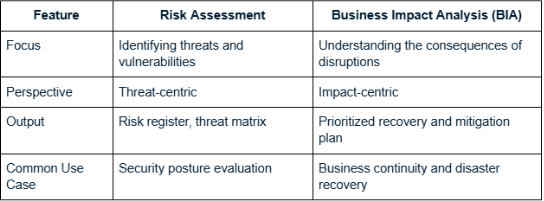
Unlike traditional risk assessments, which focus on threat probabilities, a BIA is impact-centric. It answers one crucial question: If our systems were compromised, how would it affect our operations and bottom line?
Core components of a Cyber BIA:
Identification of critical business functions
Assessment of data and system dependencies
Evaluation of financial and operational impacts
Prioritization of recovery time objectives (RTOs)
Mapping cyber threats to business outcomes
A Cyber BIA helps leaders make informed decisions about where to invest in cybersecurity services, how to strengthen business IT services, and how to align network security solutions with actual business priorities.
The Difference Between Risk Assessment and BIA
While often confused, risk assessment and BIA serve distinct but complementary purposes:
Identifying Critical Business Functions and Assets
One of the first steps in a Cyber BIA is determining what parts of the business are essential to survival and success.
Which systems and applications are mission-critical?
What data-financial, customer, and operational must remain available?
Which teams or roles are indispensable during a crisis?
Key assets often include:
Customer relationship management (CRM) systems
Financial processing platforms
Manufacturing or operational control systems
Proprietary databases and intellectual property
Communication platforms (email, VoIP, etc.)
The Importance of Business Impact Analysis in Cybersecurity
Cybersecurity is no longer just an IT concern — it’s a boardroom issue. A well-executed Cyber BIA turns abstract threats into tangible business risks, making it easier to:
Justify investments in cybersecurity company solutions
Prioritize budget allocation based on business value
Create effective data security services protocols
Train staff based on real operational risks
A Cyber BIA helps you:
Align security efforts with business goals
Understand the ripple effects of cyber incidents
Build executive buy-in for cyber investments
Without a BIA, you’re relying on guesswork-not strategy.
How a Cyber BIA Assesses the Potential Impact of Attacks
A Cyber BIA simulates various attack scenarios and evaluates their potential outcomes across the organization.
Sample attack scenarios:
Ransomware encrypts your customer database
DDoS attacks are bringing down e-commerce operations
Insider threats leaking sensitive R&D data
Impact assessments typically examine:
Financial losses (direct and indirect)
Downtime duration and cost
Reputational harm and brand damage
Legal and regulatory repercussions
Loss of competitive advantage
This analysis informs your business IT services playbook for response and recovery.
Treating it as an IT-only exercise: Involve business leaders and functional heads.
Ignoring third-party dependencies: Include vendors and service providers in your analysis.
Failing to quantify impacts: Use financial data and operational KPIs.
One-and-done mindset: A BIA must evolve with your business.
Regular reviews and continuous improvement are critical to BIA success.
Tools and Frameworks to Support BIA
Leverage industry-standard tools and frameworks to simplify and structure your Cyber BIA process.
Popular options include:
NIST SP 800–34: Contingency Planning Guide
ISO 22301: Business Continuity Management
Fair Institute: Risk quantification models
Business Impact Analysis templates from leading cybersecurity companies
There are also BIA modules within many GRC (Governance, Risk, Compliance) platforms, and some business IT services providers offer managed BIA assessments.
In an era where data is currency and digital operations are mission-critical, no business can afford to operate without a Cyber BIA. It’s the bridge between security threats and business the roadmap to protecting what truly matters.
Whether you’re a startup scaling rapidly or a global enterprise juggling compliance across regions, a Cyber Business Impact Analysis ensures that your cybersecurity services, data security services, and network security solutions align with your highest-value assets and operations.
At CyberShield IT, we offer a range of solutions to help you strengthen your cybersecurity posture. Contact us today to learn more about how we can help you safeguard your business from cyber threats.
Frequently Asked Questions
1. How is a Cyber BIA different from a traditional risk assessment?
A traditional risk assessment focuses on identifying threats and vulnerabilities. A Cyber BIA, on the other hand, emphasizes understanding the impact of those risks on business continuity, financial performance, and operations.
2. Can small businesses benefit from a Cyber BIA?
Absolutely. Even small businesses rely on data, applications, and IT infrastructure. A Cyber BIA helps smaller organizations allocate limited resources effectively.
3. How does a Cyber BIA support compliance efforts?
Many regulations like HIPAA, GDPR, PCI-DSS, and ISO 27001 require risk and impact assessments. A Cyber BIA helps demonstrate due diligence and supports documentation for audits and regulatory reviews.

Comments