How can Japanese passport holders apply for a Djibouti e-Visa online?
Are you going on a trip between the Land of the Rising Sun and the colorful Horn of Africa? Djibouti is a one-place tourist destination, offering a unique mix of volcanic landscapes, salt lakes, and exceptional diving experiences. However, before you can witness the famous whale sharks in the Gulf of Tadjoura, you must secure legal entry.

The Djibouti e-Visa for Japanese Citizens has made the application process simple and convenient. Japanese passport holders planning short-term travel can now apply online, removing the need to visit a physical embassy in Tokyo. This streamlined system allows travelers to prepare their journey to Djibouti with ease and confidence.
What is the eVisa for Djibouti?
Djibouti e-Visa is an electronic travel approval, which enables the Japanese nationals to go to Djibouti to visit the country or conduct business or transit through the country. The whole application is done online as compared to a conventional stamped visa. Upon approval, the visa is forwarded to your email whereby you are required to print it and present it at the border.
Key Highlights for Japanese Travelers:
- Convenience: No need to mail your passport to the embassy.
- Speed: Faster processing compared to traditional methods.
- Accessibility: Apply from your home or office in Japan.
What is a Transit e-Visa for Djibouti?
In case you are flying across Djibouti on your way to some other country (like Ethiopia or Somalia) and decide to leave the airport, then you will require a Transit e-Visa.
The given type of visa is created to cover short-term visits when the traveler is just in transit. General practice: It generally covers a maximum of 14 days stay. It is necessary to mention that this electronic permit is obligatory even when you are visiting the airport only during 24 hours, however, you plan to spend the night at a hotel located out of this airport.
Can Japanese Citizens Get a Visa on Arrival in Djibouti?
Djibouti is to a large extent switched to the electronic system of visa as of May 2018. Although there might be limited facilities of Visa on Arrival on certain nationalities with conditioned restrictions, it is highly advised that Japanese citizens should secure their e-Visa online before they travel.
A lack of e-Visa may result in heavy congestion of the Ambouli International Airport or even refusal of entry. The e- Visa is your pre-approved entry permit, and makes your landing at the immigration an easy process.
What is the travel document for Djibouti?
Before you embark on your Djibouti adventure, ensure you have all the necessary documents for your e-Visa application. Here is a quick rundown of what you will need:
- Valid Japanese Passport: Your passport must have at least 6 months of validity remaining after your planned departure from Djibouti. Prepare a clear scanned copy of the biographical page.
- Applicant Photograph: A recent passport-style photograph (digital copy in JPG or PNG format). The background should be white, and your face should be clearly visible.
- Proof of Onward Travel: A confirmation of your return flight to Japan or a ticket showing your journey to a third country.
- Accommodation Details: A hotel booking confirmation or an invitation letter from a host in Djibouti.
- Payment Method: A valid Visa, Mastercard, or Amex for the visa fee payment.
- Valid Email Address: This is where your approved e-Visa will be sent.
How do I apply for an eVisa for Djibouti?
The application process is straightforward and can be broken down into four simple steps when you Apply for Djibouti eVisa , making it easy for travelers to complete the process online.

- Fill the Online Form: Enter your personal details, passport info, and travel dates.
- Upload Documents: Attach your scanned passport bio-page and digital photograph.
- Pay the Fee: Use a secure credit or debit card to pay the processing fee.
- Download & Print: Once approved, download the PDF from your email and print at least two copies.
How long does an eVisa take to be approved?
The processing time should be 72 hours (3 business days) when it comes to the Djibouti e-Visa application process. But it is always prudent to do so at least one week prior to the date of departure so as to take into consideration any Djibouti public holidays (which are held on Fridays and Saturdays).
Validity Rules:
- The e-Visa is valid for 90 days from the intended arrival date you enter on the form.
- The permitted stay (14 or 30+ days) begins the moment you clear immigration.
- Entry Type: The e-Visa is strictly for Single Entry. If you leave Djibouti to visit a neighboring country and wish to return, you must apply for a new visa.
How fast can you get an e-visa?
In case of an emergency that was last minute or an unexpected business meeting, then the services of "Urgent" or "Rush" processing are usually offered by specialized agencies. The normal government time is 3 days although an urgent processing will sometimes decrease the waiting time to 24-48 hours at an extra service fee.
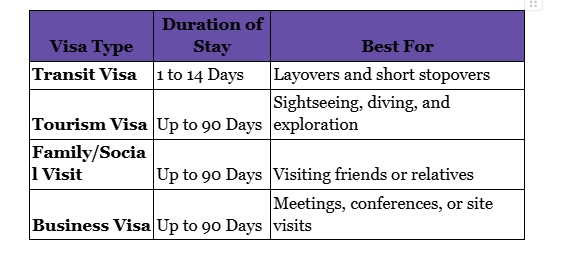
What is the difference between visa validity and duration of stay?
Depending on your purpose of travel, you can choose from the following categories:
How to track an e-visa?
Once you submit your application, you should use the tracking number provided to monitor its progress. Tracking is vital because it allows you to:
- Stay Informed: Know exactly when your visa is ready.
- Prevent Delays: If a document is rejected (e.g., a blurry photo), you can fix it immediately.
- Plan Confidently: Confirm your flight and hotel bookings only when you see the "Approved" status.
- Identify Issues: If the 72-hour window passes without an update, you can proactively contact the authorities.
How can you complete the Djibouti e-Visa application smoothly using the online system?
The process of applying to have a visa is at times daunting but with a few tips offered by the experts, the process could be painless. In order to prevent all the pitfalls and make sure that your entry into Djibouti is not postponed, remember about the following important tips:
- Synchronize Your Dates: Make sure the arrival date you type into the form is the exact same date shown on your flight tickets to avoid any confusion at the border.
- Prioritize Scan Quality: Use a high-quality scanner or a steady phone camera. Your passport photo and data must be clear, without any bright light reflections or dark shadows.
- Physical Backup is Essential: Don't rely on your phone screen alone. Print out two physical copies of your e-Visa to hand over to immigration officers when you land.
- Mind Your Health Documentation: Carry your Yellow Fever shot record if you are traveling through an area where the virus is present before reaching Djibouti.
- Check Your Spam Folder: Keep an eye on your junk mail daily. Sometimes the official approval email gets caught in your filters by mistake.
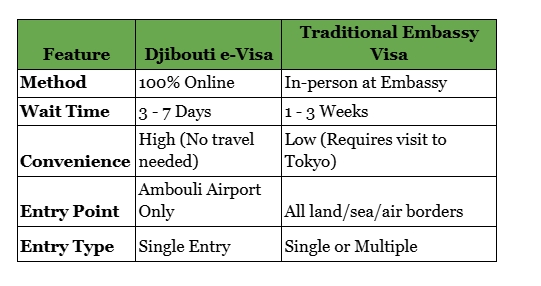
What is the difference between eVisa and traditional visa?
Is the e-Visa always the best choice? Here is how it compares to the traditional sticker visa:
What to pack for a travel checklist?
Djibouti is hot. As a Japanese traveler, your packing list should include:
- Modest Clothing: Djibouti is a Muslim-majority country; keep shoulders and knees covered in public.
- Sun Protection: High-SPF sunscreen, polarized sunglasses, and a wide-brimmed hat.
- Universal Adapter: Djibouti uses Type C and E sockets (European style). Japan uses Type A/B, so you will need a converter.
- Hydration Tablets: The heat can be intense; electrolytes are a lifesaver.
What are the Emergency Numbers in Djibouti?
It is always better to be prepared. Save these numbers before you land:
- Police: 17
- Fire Department: 18
- Ambulance/Medical: 19
- Japanese Embassy in Djibouti: +253 21 35 49 81
How to Handle Taxi and Transport in Djibouti?
Getting around Djibouti City is relatively easy if you follow these tips:
- Green Taxis: These are the official city taxis. They do not use meters, so negotiate the fare before getting in.
- Night Surcharge: Be aware that taxi fares usually increase by 50% after dark.
- Minibuses: For a local experience, minibuses run on set routes for a very low flat fare.
- Car Rentals: If you plan to visit Lake Assal, renting a 4x4 is highly recommended as roads in the interior can be rugged.
Conclusion:
A potential entry obstacle to Djibouti does not need to get into the way of your travel plans. Through the simplified e- Visa system, the Japanese travelers no longer have to go through the antiquated system of the Tokyo embassy and ensure their passage through any laptop. The point is that you should care about the digital application as much as you would care about a high-stakes flight book: you should check all the dates, scans of your passport are supposed to be as clear as ever, and the actual printouts are to be ready as well to be shown to the local authorities. Be it going to float in the salt-saturated waters of Lake Assal or snorkeling through the whale sharks, when you get your paper work sorted early you can then contemplate the scenery and the hospitality that is so striking in Djibouti. Check your arrival time twice, have your vaccination documents with you, and you will realize it was only the first stress-free step of a memorable African journey to be able to pass the Immigration check at the Ambouli.
You need to more information related to Djibouti eVisa:
- Djibouti e-Visa for Turkish citizens
- Djibouti e-Visa for Chinese Citizens
- Djibouti e-visa for Japanese Citizens
- Djibouti E-Visa for Azerbaijani Travelers
- Djibouti e-visa for Netherlands citizens
Comments